A national temporary ban on new Medicare enrollment could have long-term impacts on hospice affiliations among nonprofit providers.
Fraudsters have bilked billions of Medicare dollars posing as new legitimate providers. The program integrity issues moved the moratoria forward and caused a trickle effect on mergers, acquisitions, affiliations and organic growth in the hospice space.
This is according to Mark Kulik, senior managing director at merger and acquisition advisory firm The Braff Group. The moratoria could result in an uptick of nonprofit affiliations, particularly in states with certificate of need (CON) policies, Kulik indicated.
“If [the moratoria] doesn’t lift, it may go longer than six months and be extended during the Trump administration because there’s so much pressure to find the fraud,” Kulik told Hospice News. “If the moratorium stays in place, then these nonprofits are certainly as much of an attractive target as a for-profit, especially if you look at certain CON states. There are no other options, and that’s going to elevate the attractiveness and valuation for these nonprofit providers.”
Affiliations during fraud firewall
The U.S. Centers for Medicare & Medicaid Services’ (CMS) six-month hospice and home health moratoriaare set to expire Nov. 13. The national moratoria prohibit applications for new Medicare enrollment, and they apply to certain changes in majority ownership for hospices and home health agencies.
CMS stipulated that it would give at least 60 days’ notice prior to the moratoria’s expiration. To date, the agency has not provided information on whether the moratoria will be extended.
During the moratoria, organic growth has slowed to nearly a grinding halt for Medicare certifications in various stages of application and regulatory approval, Kulik said. For-profit and private entity investors have sought growth in other ways, pivoting toward mergers, acquisitions and affiliations among nonprofits.
Should the moratoria end as slated, the “valve could open pretty quickly” in terms of de novo activity, Kulik said. Nonprofit assets may be more aggressively sought after as high-quality assets by for-profit and private equity buyers, he indicated.
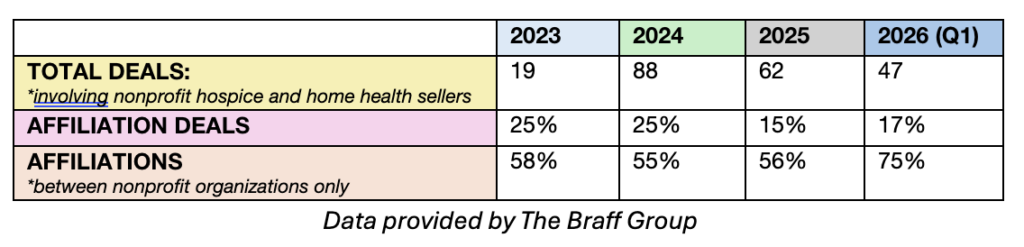
The actual volume of hospice and home health affiliations is difficult to determine without financial transaction details involved, according to Kulik. Many of the smaller deals are underreported and underrecognized, or they are not announced publicly at all, he said.
An “interesting dynamic” is occurring in particular this year, according to Kulik, who projected an uptick in nonprofit-specific hospice deals.
“The nonprofit-to-nonprofit connection has been almost at a 45-degree angle increase,” Kulik said. “There are burdens that didn’t exist before, and that’s causing nonprofits to have a thinner margin to look at how they protect their mission. Do they build economies of scale? Do they merge with another nonprofit? Those are reasons why I think we’re going to see a percolation of more activity going forward. I don’t see any of those pressures letting up on top of demand.”
Evolving to sustain
Organizations that have recently announced or completed an affiliation are Cadre Hospice and Inspire Hospice and Palliative Care, as well as HomeCare & Hospice of the Valley and Sangre de Cristo Community Care.
Among the larger nonprofits active in hospice and other healthcare affiliations are Empath Health and Chapters Health System.
Established in 1983, Chapters Health offers hospice, palliative care and home health through a network of 30 medical organizations and programs. The nonprofit also provides durable medical equipment, pharmacy services and Programs of All-Inclusive Care for the Elderly (PACE).
Chapters Health recently completed its affiliation with Oregon-based Housecall Providers. Announced in February, the deal expanded the nonprofit’s offerings in hospice, home-based and advanced illness care. Chapters also provides services in Florida, Georgia, New York and New Jersey, among other states.
Nonprofit hospices are increasingly seeking collaborative affiliations to better position themselves financially amid rising demand and increasing care costs, according to Andrew Molosky, president and CEO at Chapters Health.
“I think the biggest evolution is actually the number of organizations that see affiliations, regardless of the structure, as the path forward,” Molosky told Hospice News in an email. “I believe the industry is embracing the need to band together, to share resources and [to] find benefits of scale at a rate that is unprecedented, and that is elevating the overall discussions across the board. Interest in partnering is increasing, while the goals of each organization and the need for creativity have evolved over time.”
The initial changes involved in affiliation processes can be difficult to navigate, Molosky said. However, the benefits of these agreements for Chapters Health have thus far included greater sustainability, increased staff satisfaction and improved quality scores, he stated.
Alignment of organizational culture is a key consideration in the sustainability of an affiliation, according to Molosky. Having similar missions and values allows both organizations to “exponentially grow” together, he said.
Identifying an affiliate target involves examining several organizational aspects such as employee recognition policies, professional development opportunities and approaches to high-quality care delivery and access, according to Molosky. Organizations pool their administrative functions and clinical resources together to build economies of scale for post-affiliation growth, he said.
The scope of hospice affiliation agreements is evolving, according to Tarrah Lowry-Torres, COO at Empath Health. Smaller nonprofits have often sought larger organizations to preserve their local identities and community-based services, she said.
“We’re seeing nonprofit hospice affiliations evolve beyond traditional consolidation models,” Lowry-Torres told Hospice News in an email. “In the past, affiliations often meant adopting a single brand and centralizing nearly every function. Increasingly, organizations are looking for ways to preserve local identity and community trust while benefiting from the scale and resources of a larger system.”
Florida-based Empath Health provides hospice, palliative care, home health, bereavement, HIV and sexual wellness care and PACE programs. The nonprofit emerged from a 2020 merger with Stratum Health.
Empath Health recently completed its affiliation with Florida-based Trustbridge. The combined organization Empath Trustbridge Health now serves one-in-five Florida hospice patients daily. The nonprofit’s other hospice affiliates include Empath Hospice, Hospice of Marion County, Suncoast Hospice, Suncoast Hospice of Hillsborough and Tidewell Hospice.
Mission alignment is the primary focus of Empath Health’s “strongest affiliate relationships,” Lowry-Torres said. The most successful affiliations are rooted in a shared goal to strengthen care
Across each organization’s respective service region, not solely oriented around a growth initiative, she stated.
Hospices seeking an affiliation are typically looking to expand access while improving quality and sustainability, Lowry-Torres indicated. Post-affiliation longevity often depends on maintaining trust among local referrals and community partnerships. Also key is having financial resources to invest in workforce development, clinical excellence, technology initiatives and compliance, she said.
“We consider whether we can be stronger together,” Lowry-Torres said. “Today’s healthcare environment is increasingly complex. Hospices benefit from the scale that comes with shared infrastructure and best practices, but they also need the flexibility to remain responsive to local needs. The organizations that strike that balance are best positioned for long-term success.”
Companies featured in this article: