


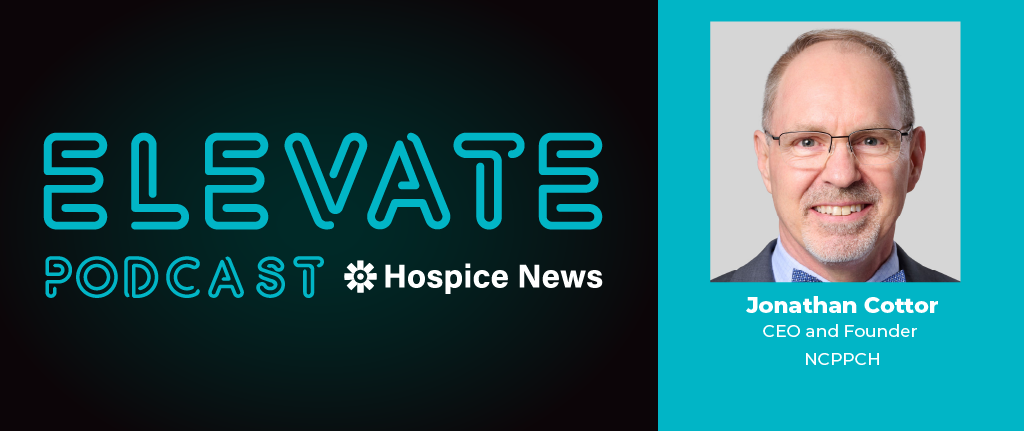
Families often experience complex emotional, physical and logistical challenges when a child has a serious or terminal condition. Slow-moving state and federal policy are not keeping pace with the growing demand for improved support.
This September, the Hospice News Elevate podcast explores the legislative, operational and financial keys to expanded support and access among underserved pediatric populations nationwide.
Hospice News sits down with Jonathan Cottor, CEO and founder at the National Center for Pediatric Palliative Care Homes (NCPPCH). The organization focuses on improving community-based pediatric palliative and respite care through increased education, policy advocacy efforts and offering support, guidance and best practice to providers.
Cottor is also co-founder of Ryan House in Arizona, named in memoriam of his son. Ryan died at the age of 17-years-old due to a serious illness. Launched in 2004, the nonprofit pediatric palliative care home provides end-of-life support and short-term caregiving to children with medical complexities.
Editor’s note: The following transcript has been edited for length and clarity.
How has the national landscape of pediatric end-of-life support evolved in recent years?
I’ve been around this kind of work now for [more than] 25 years. I’ve really seen an evolution and a change. I really am excited about today as an environment very different than it was five years ago, 10 years ago and 20 years ago when I started to get into this with my own family journey with our son.
Some of the things that have really evolved and why today is such an exciting moment to have these kinds of conversations is … that the idea of pediatric palliative care is very different today than it was 20-plus years ago.
One of the key recognitions is that it’s now a recognized specialist program through the American Academy of Pediatrics. Most children’s hospitals today now have dedicated pediatric palliative care teams, which did not exist 20 plus years ago. That’s a huge element, that there’s a lot of professionals and expertise in this area now talking about this.
It’s also more than that. It’s really a bigger societal environment. I think mental health, stress and strain is talked about much more today than it was 10 years ago plus. The importance [and] the idea of caregiving is really recognized in the national conversation. What caregivers and the family units are going through in support of the person, whether it’s elder care or especially in the case of a child, is really very different today. And that’s what I think gives us a foundation of excitement today.
What is the current scope of hospice, respite and palliative care delivery?
We talk a lot about children who have very significant medical complexities, many of which may not live into adulthood. With life-limiting conditions and life-limiting illnesses, these families have been around forever. That’s not a new population. Those families have been on these journeys [and] communities have been trying to come up with support systems to help those families through those journeys. Those systems have also been around for decades. But community-based care models … really struggled because the philanthropy weight is so strong and that’s very difficult to sustain a model like this.
What are some of the important public policy trends to note in pediatric hospice and palliative care policy at both state and federal levels?
There’s now a lot conversation about community-based models. There is starting to become some state-level successes in terms of legislation, department of health regulations and Medicaid state-level groups are starting to build out what could be a new way forward.
Today, as those programs and models are starting to be shared, I think policymakers and other thought leaders are looking at those and going, “Hey, wow, this could work. This actually makes sense.”
Let’s figure out and lean into how to make these things much more systemized and really look at how to reframe children’s healthcare differently than what we’ve historically done. This is really a time in our evolution to start fresh and really think about how to approach this from a child and family holistic perspective.
What is needed to improve end-of-life care access among underserved terminally and seriously ill children? What are the potential policy or reimbursement barriers that impact access to and sustainable community-based care infrastructures?
Leaders at various different state department of health-level groups have thought the solution is concurrent care. That’s really where they’ve leaned into and thought they’re covering kids’ needs because they have concurrent care.
The reality of concurrent care is … if the person hasn’t elected hospice, concurrent care is not involved. It’s just care. People in the [pediatric] industry need to really recognize where does that timeline start, and that these families need the support way more upstream during the months and years leading up to the end of life. Then, when the end of life happens, those kinds of concepts come into play.
Listen to the Elevate podcast in full here:
Companies featured in this article:
National Center for Pediatric Palliative Care Homes, Ryan House
