
Two analyses have scoured healthcare trends to uncover factors impacting access to quality end-of-life care.
Researchers also examined how end-of-life decisions are made among families, as well as the barriers that clinicians see in certain care settings.
Nurses Uncover 4 Common Hospice Disparities
Hospice and palliative care nurses recently revealed four common factors associated with access to quality end-of-life care.
Researchers from Rogers State University and Omega Home Network examined the perceptions of 11 nurses in a study recently published in the American Journal of Hospice and Palliative Care Medicine.
Nurses that participated in the study identified four key factors affecting quality. These themes included care setting, education and communication, caregiver burden and relationship-based care. The study spanned nurses providing end-of-life care in long-term care, social model hospice homes and home-based settings.
Hospice providers should recognize that nurses’ ability to provide quality end-of-life care is “strongly influenced” by the environment in which care occurs, according to Kelley Scott, co-author of the study.
“One of the most important messages for hospice providers is that hospice nurses operate within a larger care system they do not fully control,” Scott told Hospice News in an email. “Their expertise in symptom management, communication, advocacy and family education may be consistent, but their ability to use that expertise varies considerably by setting.”
The study’s findings point to need for change at a system–level approach, rather than looking for structural or individual deficiencies among nursing staff, Scott stated.
Scott, a registered nurse, is also founder and executive director at Omega Home Network. The Oklahoma-headquartered nonprofit organization provides community-based nonmedical hospice support in a home setting. The network of more than 100 community homes spans 35 states and includes Clarehouse, which is a social model hospice home.
Setting-based care disparities exist, study respondents indicated. Social model hospice settings were found to be the most supportive of individualized care, according to the analysis. Home care access and quality depended on the availability of adequate resources. Meanwhile, significant challenges existed in long-term care settings, due to staffing, regulatory and resource constraints, the study found.
Hospices can improve access by strengthening referral partnerships and education in varied healthcare settings, according to Scott. Upstream family caregiver support and communication are also critical, as is advocating for sufficient staffing and resources.
“Hospice providers should also recognize caregiver burden as a quality-of-care issue, not merely a family issue,” Scott said. “Nurses play an essential role in symptom management, education, communication and advocacy, but staffing limitations, caregiver exhaustion and misconceptions about hospice and medications can undermine care.”
Demographic Inequities in End-of-Life Decision Makers
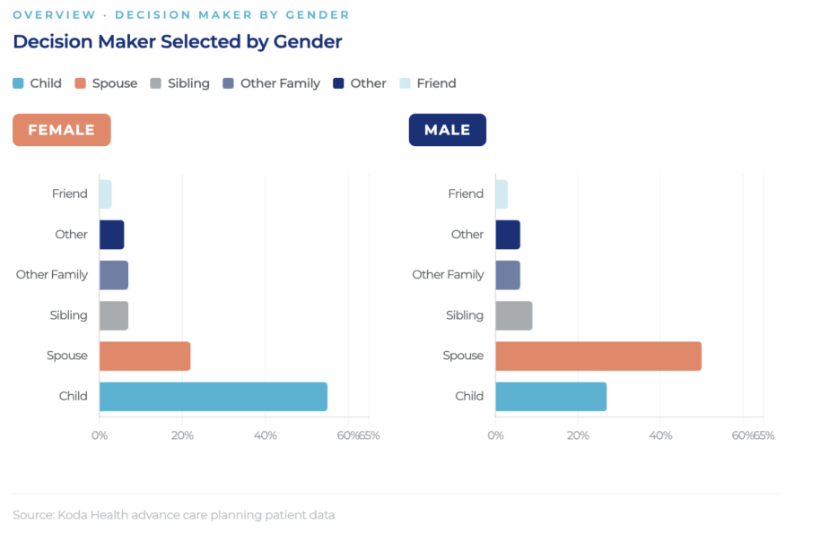
Recent data have found that healthcare decisions are a responsibility most often delegated to and by women versus men.
More than half, or 55%, of women name an adult child as their primary medical decision maker compared to 27% of men, according to Koda Health data shared with Hospice News.
Men are more likely to name a spouse as their healthcare proxy 50% of the time, versus 22% of women, the data found. Additionally, nearly three-quarters of adults in the United States do not have their goals-of-care documented.
Family caregivers supporting more than 1 million patients were “disproportionately” adult daughters responsible for making medical decisions or taking on these roles by default surrogate laws and health system workflows, according to the data.
The findings illustrate significant systemic challenges that impact goal-concordant end-of-life care delivery, said Dr. Tatiana Fofanova, CEO and co-founder of the advance care planning platform Koda Health.
“At the core of this study is that the standard of care in medicine and the default standard in our legal system is a spouse-first medical decision-maker responsibility,” Fofanova told Hospice News. “In reality, that default only works for about half of men and misses the majority of women. It’s a huge impact to caregiving as a whole, because the majority of America’s caregivers are the oldest daughter, and that is most disconcerting. That’s a huge gap that we see across the space.”
Patients and their families often do not receive advance care planning support until a loved one reaches a critical stage in their health, Fofanova said. This negatively impacts outcomes for health systems and family caregivers, particularly when it comes to quality and cost at the end of life.
Families need better access to goals-of-care communication, according to Fofanova. A lack of family and patient engagement can result in distressed healthcare decision making and severe financial struggles, she stated. Normalizing conversations about the end of life, death and illness involves a collaborative approach among healthcare providers.
“Advance care planning and goals-of-care conversations are critical to caregiving,” Fofanova said. “They help caregivers understand the treatment interventions and quality-of-life lines in the sand that are acceptable to the person they are caring for. Caregivers say they experience ‘extreme distress and guilt’ over these decisions. Having those instructions can relieve the burden on caregivers. Critical to driving them forward is normalizing them and making sure families are able to be engaged.”
Companies featured in this article:
Clarehouse, Koda Health, Omega Home Network, Rogers State University