

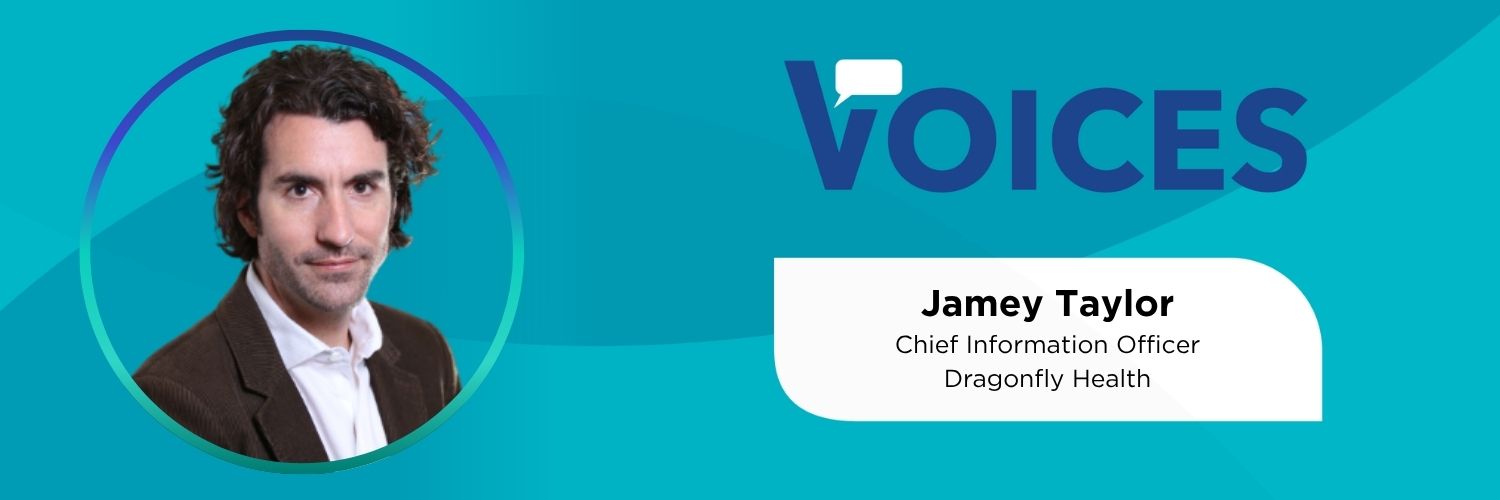


This article is sponsored by Dragonfly Health. As hospice and post-acute care organizations look to reduce complexity across care delivery, technology is playing a growing role in connecting workflows, improving coordination and supporting clinicians at the point of care. Dragonfly Health is building a more unified care-at-home ecosystem across DME, pharmacy and clinical operations. In this Voices interview, Jamey Taylor, Chief Information Officer at Dragonfly Health, shares how his team approaches innovation, what it takes to build technology that supports growth, and how a more connected platform can improve the experience for providers, patients and caregivers.
Hospice News: What life or career experiences have most shaped your approach to the work you’re doing today?
Jamey Taylor: When I look back at my career and why I’m here, it has really been centered on three things, all of which fit really well into my experience at Dragonfly Health: IT integrations (bringing systems, teams, and companies together to operate as one), building truly differentiating proprietary technology, and assembling mission-oriented teams. That’s what creates value and makes me excited about getting up in the morning. That’s also what drives our mission at Dragonfly Health. My team builds the care-at-home technology that supports people out in the field so the patient or caregiver has the best possible experience, especially when unexpected challenges arise.
What motivates you on a day-to-day basis?
What keeps me motivated is twofold. First, we are building foundational, category-creating technology—like the DME Benefit Management space our teams pioneered—that simply didn’t exist before. Second, this is the first job I’ve had that truly matters — with a capital M — to the people we serve. That’s because my team’s work product has a direct line to patients and their caregivers at a critical, challenging time in their lives. That feels good. For that reason, I believe I have found my “forever home” in healthcare.
How have you structured your technology organization to support innovation and growth?
We treat our technology department as a strategic operating asset rather than a back-office maintenance function. We deliberately organized our department around core operational capabilities instead of traditional applications. We have dedicated engineering and technology teams focused specifically on pharmacy operations, DME operations, billing and cost containment, user experience, and a shared platform layer that spans our entire ecosystem.
This structure allows our IT professionals to be nimble, to focus on the total experience for all constituents, and to feel the direct connection of their daily development work to business growth, clinician needs, and value creation. We are focused on providing a world-class order coordination experience to the patients, members, and caregivers. We are focused on providing clarity and certainty to clinical teams working within our platform. We are focused on improving quality and managing costs for all stakeholders. The results speak for themselves. This structure has driven rapid innovation across our lines of business.
Dragonfly Health is actively building a unified platform across DME and pharmacy. How will this improve the experience for clinicians, clients and care teams?
The primary vision is removing friction across the entire clinical workflow. Today, clinicians often navigate multiple systems and a variety of manual processes. Our goal is to simplify workflows so care teams can spend less time on administrative tasks and more time focused on patients.
By bringing DME and pharmacy workflows together, we’re creating a more connected experience that reduces complexity and makes it easier to access the information needed to make informed clinical decisions. We are also embedding clinical decision-making support into our systems so nurses can easily select the most appropriate, cost-effective equipment and medications.
Ultimately, we’re reducing both direct costs and hidden costs associated with unnecessary complexity. Our goal is to create a technology experience that fades into the background, allowing clinicians to focus entirely on caring for patients while technology seamlessly connects the services, information, and workflows that support them. We are also very deliberate about balancing technology with personal service. Humans remain at the center of every important decision.
What projects are you most excited about right now?
We’ve created an innovation flywheel that constantly delivers new features and improvements. Right now, I’m especially thrilled with the results we’re seeing in our enhanced order coordination pilot for DME deliveries. This represents the culmination of a vision we’ve been talking about since my first week here. So much care coordination historically was manual—scheduling calls, status updates, follow-ups—taking clinicians away from patient care. We’re replacing those friction points with direct control through smart scheduling, self-service patient and caregiver tools—like selecting or updating delivery windows directly in the app without making multiple phone calls—real-time delivery visibility, automated ETAs, and intelligent route sequencing for field technicians.
What’s most exciting is how this enhancement reflects where we are as a company. When I came onboard nine years ago, even if we had built the technology, we couldn’t have delivered it, because technology alone does not solve the needs of the market. Dragonfly Health now operates at the scale required to drive adoption within third-party networks while maintaining quality. All the pieces had to come together to make automated coordination possible today. It’s also a powerful example of what’s possible when technology, operations, and service delivery are designed to work together as one connected ecosystem.
As Dragonfly Health continues to grow beyond its hospice roots, how does that benefit the hospice organizations you serve?
Hospice care is the foundation of our business and the bedrock of everything we’ve built. When we look at expanding across the care continuum, our goal is to build a more connected care experience that makes hospice transitions easier for providers, patients and caregivers.
Transitioning a patient into hospice can be an administrative hurdle for care teams faced with immediate setup requirements. By establishing a connected ecosystem earlier in the care journey, we simplify care transitions. Eliminating upstream fragmentation of data and services directly removes admission friction for hospice clinicians, enabling faster, more reliable care delivery when time is of the essence.
In the hospice industry, the next 12 months will be shaped by…
The next 12 months will be shaped by integration and clinical intelligence—all built on a durable foundational architecture and delivered in service of the patient, clinician, and caregiver.
Editor’s Note: This article has been edited for length and clarity.
Dragonfly Health is a care-at-home operating platform designed to bring clarity, integration, and accountability to complex care delivery. By combining flexible DME and pharmacy access, advanced technology, robust analytics, and dedicated clinical and account management support, Dragonfly helps hospice and post-acute care providers turn utilization data into actionable insights—improving outcomes, optimizing resources, and reducing burden on clinical teams. With more than 20 years of experience supporting millions of patients annually across all 50 states, Dragonfly Health partners with organizations committed to delivering high-quality care at home. To learn more, visit www.DragonflyHealth.com.
The Voices Series is a sponsored content program featuring leading executives discussing trends, topics and more shaping their industry in a question-and-answer format. For more information on Voices, please contact [email protected].
