Many healthcare providers presume that a spouse will be a patient’s healthcare surrogate decision maker. However, new data show that this may not be the case.
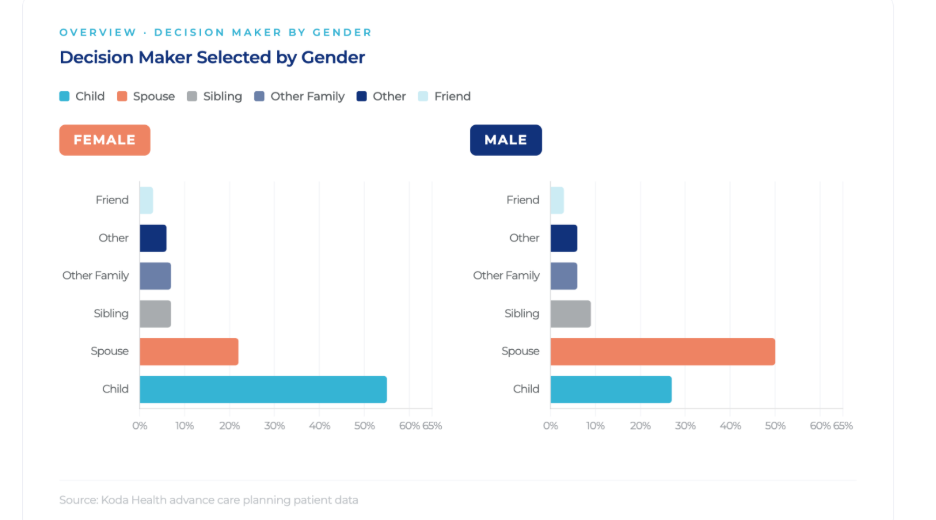
Research from the advance care planning company Koda Health found that women name an adult child as their primary medical decision maker 55% of the time, compared to 27% of men.
Men name their spouse about 50% of the time. For women, this is 22%.
“This data challenges that longstanding assumption that you know we are always going to choose our spouse when it comes to medical decision maker selection, and the reality is that women overwhelmingly choose a child over a spouse, even when they have a spouse to choose,” Tatiana Fofanova, CEO of Koda Health, told Hospice News. “Men more often choose a spouse, but it’s still only about half the time, which really means it’s unfair to everybody to have that as the default from a clinical perspective.”
In most states, when no advance directive is in place, the law defaults to a spouse as the surrogate decision-maker. That legal standard, however, often conflicts with what many people report they would prefer, particularly women, according to Koda’s research.
For hospice and palliative care providers, the gap has practical consequences: it influences who participates in goals-of-care discussions and whether a patient’s documented preferences are ultimately honored at the bedside.
Fofanova co-founded Koda Health in 2020 with Chief Medical Officer Dr. Desh Mohan and Katelin Cherry, the company’s chief technology officer. The three met and began collaborating at the Texas Medical Center’s (TMCi) Biodesign program, which tasked them with finding solutions to problems affecting the health system. Koda Health spun out of that work as an independent company.
The company’s EMR-integrated platform is designed to digitize patients’ decision-making around their care preferences and goals. Koda’s advance care plans documents are legal in all 50 states and are available in multiple languages.
Koda’ research took place more than six years and included a sample of 10,000 individuals.
Women’s preferences shift steadily with age, Koda Health found. By age 90 and older, roughly 84% name an adult child as their preferred decision-maker. Part of that trend likely reflects demographics: women are more likely than men to outlive their spouses.
Men follow the same general pattern, but the transition occurs later and more gradually. Even into advanced age, men are substantially more likely than women to continue naming a spouse as their preferred surrogate, Koda’s research indicated.
The results underscore the importance of advance care planning and documented end-of-life wishes, including a surrogate decision maker, according to Fofanova.
“It is incredibly important to have these conversations and to select a medical power of attorney that is actually willing and able to act on the preferences that you have,” she said. “I’m very hopeful that these insights will steer both provider and policymaker behavior to maybe stop defaulting to that erroneous perception that the spouse is always the medical power of attorney.”
Companies featured in this article: